Blog
/
Company
We’re celebrating $170 billion moved on Treasury Prime

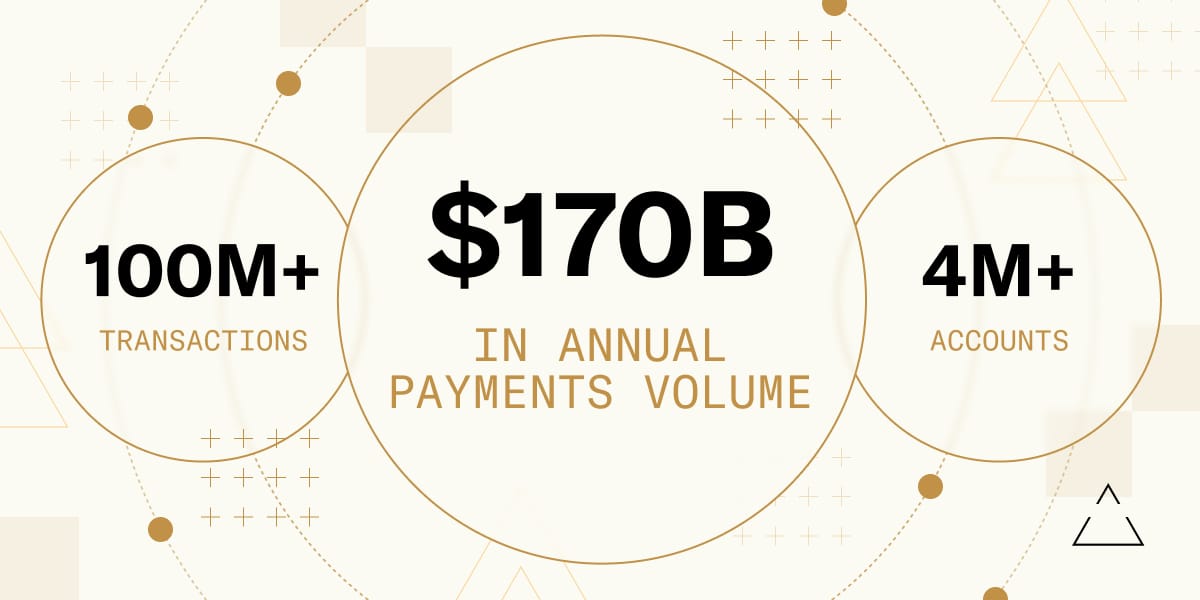
This month, money movement on Treasury Prime crossed $170 billion in trailing annual volume, across more than 100 million transactions and 4 million+ accounts. In the last 31 days, our bank partners and fintech programs moved $17.7 billion, an average of over half a billion dollars a day, with a single day this week alone crossing nearly a billion.
Numbers like that are easy to publish and easy to skim past. What matters isn't the total, it's the shape of it, because that says more about the state of embedded banking than the milestone does.
Volume is spreading across rails, not just growing
Five years ago, most embedded banking volume ran through one or two rails and stopped there. Not anymore. Over the past 31 days, roughly 62% is in traditional ACH, Wires, and our intra-bank Network Transfers protocol. But the remaining portion is rapidly growing due to the sharp increase in real-time payments.
A fintech moving money on a single rail is usually still early, proving out one use case. A fintech spanning all payments has typically built several products on the same account infrastructure: operating accounts, disbursements, card programs, treasury management. Rail mix is a better signal of program maturity than total volume ever is on its own.
Compliance has to scale with volume, or volume becomes the risk
Scaling volume is the easy story. The harder one, and the one that determines whether a program survives its own growth, is whether compliance and fraud controls scale with it. NACHA's WEB debit risk requirements, BSA/AML monitoring, and sponsor bank oversight don't get lighter as volume grows, they get heavier and less forgiving of manual exceptions.
For banks, the real question behind every new program isn't whether a fintech can drive volume, it's whether they'll still have real visibility into it at ten times the size. For fintechs, it's whether their banking infrastructure holds up when a regulator asks for an audit trail on transaction 40 million.
We built Treasury Prime around a direct relationship between fintech and sponsor bank, with no intermediary obscuring what's happening on the bank's charter. That's what lets banks keep genuine oversight as volume climbs into the billions, and lets fintechs build on infrastructure that treats compliance as part of the product, not a bottleneck bolted on after the fact.
A multi-bank network compounds differently than a single-provider model
Programs on Treasury Prime aren't tied to a single sponsor bank's balance sheet, risk appetite, or product roadmap. As bank partners grow their own programs and fintechs diversify across partners for redundancy or specific needs, volume compounds across a network rather than one point of failure. It's a slower growth curve to get going, since direct bank-fintech relationships take longer to build than plugging into one shared back-end, but a more durable one, since no single bank's constraints cap what the network can do.
"These programs didn't get here by moving money on one rail, cutting corners on oversight, or betting everything on a single bank relationship. They got here because the infrastructure underneath was built to handle more rails, more scrutiny, and more banks, all at once."
— Chris Dean, Co-founder and CEO, Treasury Prime
What $170 billion confirms
Crossing $170 billion confirms Treasury Prime's focus. The programs we power didn't get here by moving money on one rail, cutting corners on oversight, or betting everything on a single bank relationship. They got here because the infrastructure underneath is built on long term stable relationships to handle what growth actually demands: more rails, more scrutiny, more banks, all at once.
If you're a bank thinking about how to grow a program without losing oversight of it, or a fintech asking what your banking infrastructure needs to look like at 10x your current volume, that's exactly the conversation we want to have. Let's talk.
 Share
Share
